
Commodity
Gold
Target
Low Sulphidation Epithermal Gold
Location
Kyushu
Exploration Stage
Drill Testing
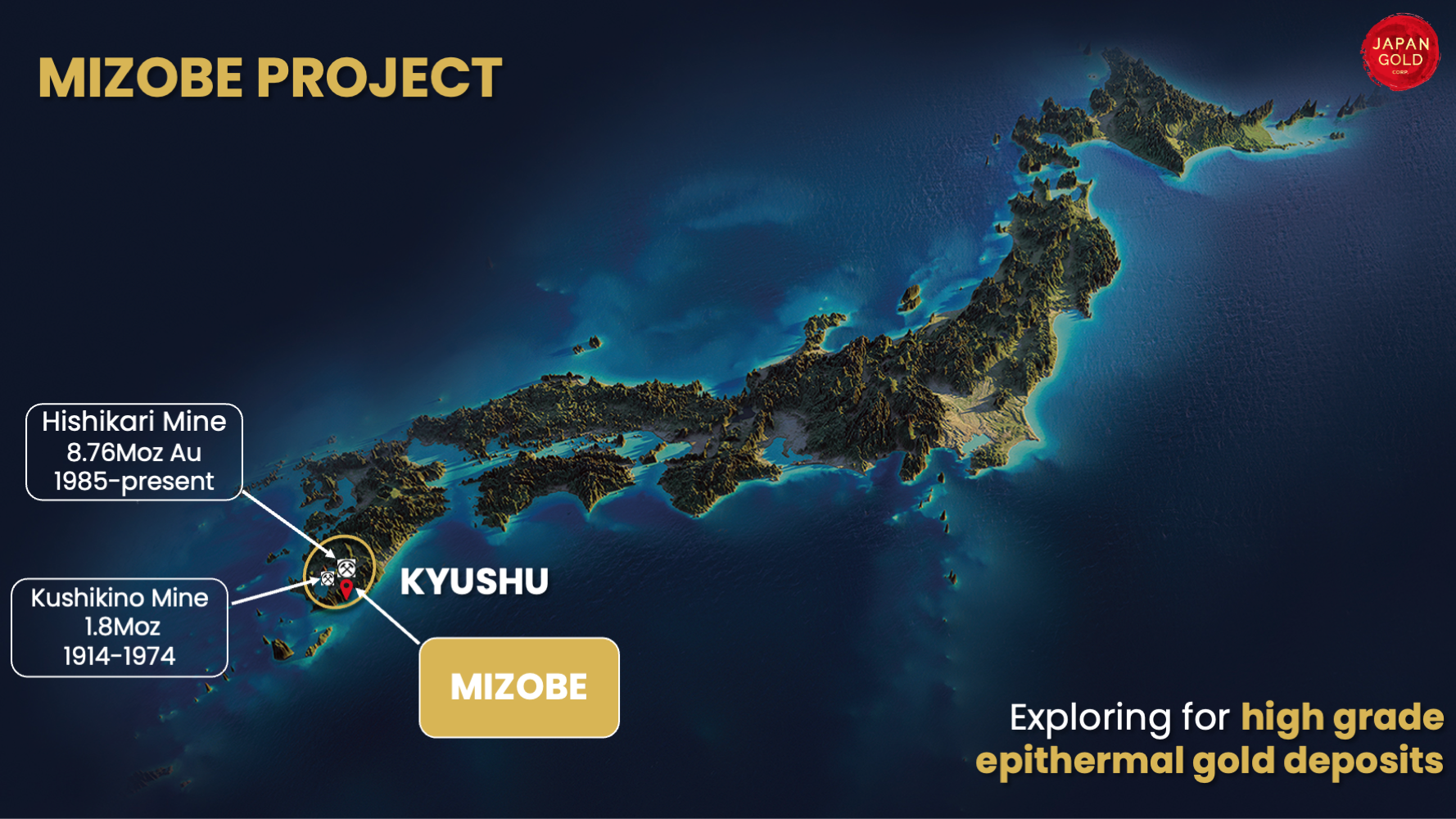
The Mizobe Project lies within the Hokusatsu Region of southern Kyushu, along the western edge of the Kagoshima Graben, 23 kms north of the Hishikari Mine. Hishikari is one of the highest-grade Tier 1 gold mines in the world. The Hishikari Mine, a 13Moz deposit, produced approximately 8.76 million ounces of gold between 1985-2025 at an average grade of +20 g/t Au, and is Japan’s only operating gold mine today. (Source: Sumitomo Metal Mining Co., LTD. Integrated Report, September, 2025).
The Hokusatsu district has produced more than 13 million ounces of gold from several mines and remains one of the most prospective regions in Japan (Sources: Garwin, S. L., Hall, R., & Watanabe, Y. (2005). Tectonic setting, geology, and gold and copper mineralization in Cenozoic magmatic arcs of Southeast Asia and the West Pacific; The Mining and Materials Processing Institute of Japan (1989, March). Journal of Japanese gold mines, Vol. 1: Kyushu, Japan Izawa, E., & Zeng, N. (2001); Kushikino gold mineralization in a Pliocene volcanic region, Kyushu, Japan. In Society of Economic Geologists (Ed.), Guidebook Series (Vol. 34, pp. 53-60). Society of Economic Geologists; Murakami, H., and Freebey, C., (2001) Geology and Geophysical Expression of the Yamagano low sulfidation epithermal Au-Ag deposit, southwest Kyushu In Society of Economic Geologists (Ed.), Guidebook Series.).
Historical mining activities within Mizobe focused on antimony-rich hydrothermal breccias at the Semari and Nakazon workings, prior to 1942. In 2000, as part of government supported regional geological surveys, the Metal Mining Agency of Japan ("MMAJ") drill hole 12MAHT-2 was drilled 1 km to the southeast of the historical antimony workings, targeting a geophysical anomaly below a mineralized outcrop grading 0.3 g/t gold. Drilling intersected a mineralized interval of 43.35 m @ 0.89 g/t gold, with an included interval of 20.3 m @ 1.16 g/t gold from 307.0 m down-hole.
The majority of the Mizobe Project area is covered by post mineral–recent volcanic ash deposits. Sampling of sporadic altered outcrop and quartz-vein breccia float across a 2 by 2.5 km area in the eastern side of the project area confirmed the presence of strong gold and pathfinder element anomalies with channel samples including composited intervals up to 24.7 m grading 1.0 g/t gold, and river float samples up to 18.9 g/t gold. The extent of gold and antimony anomalism is highly encouraging considering much of the target area is concealed by a veneer of post-mineral volcanic ash.
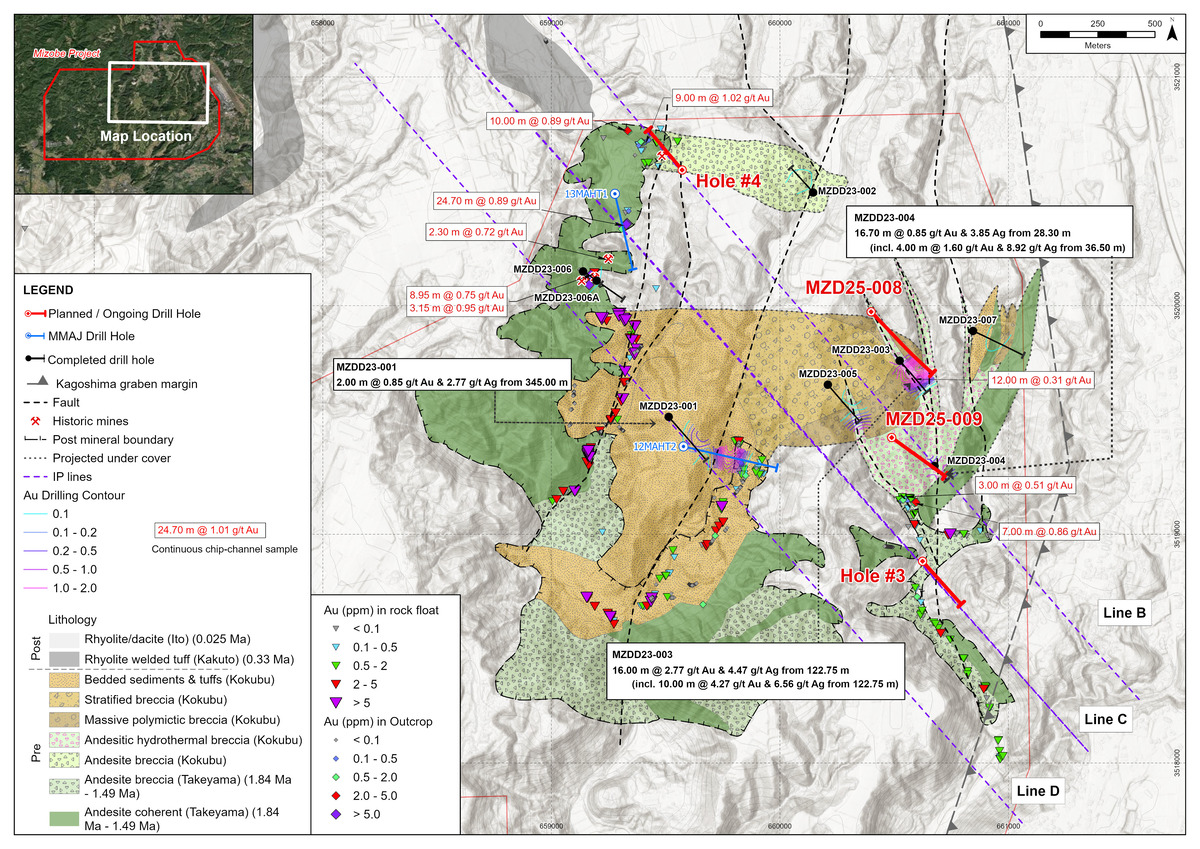
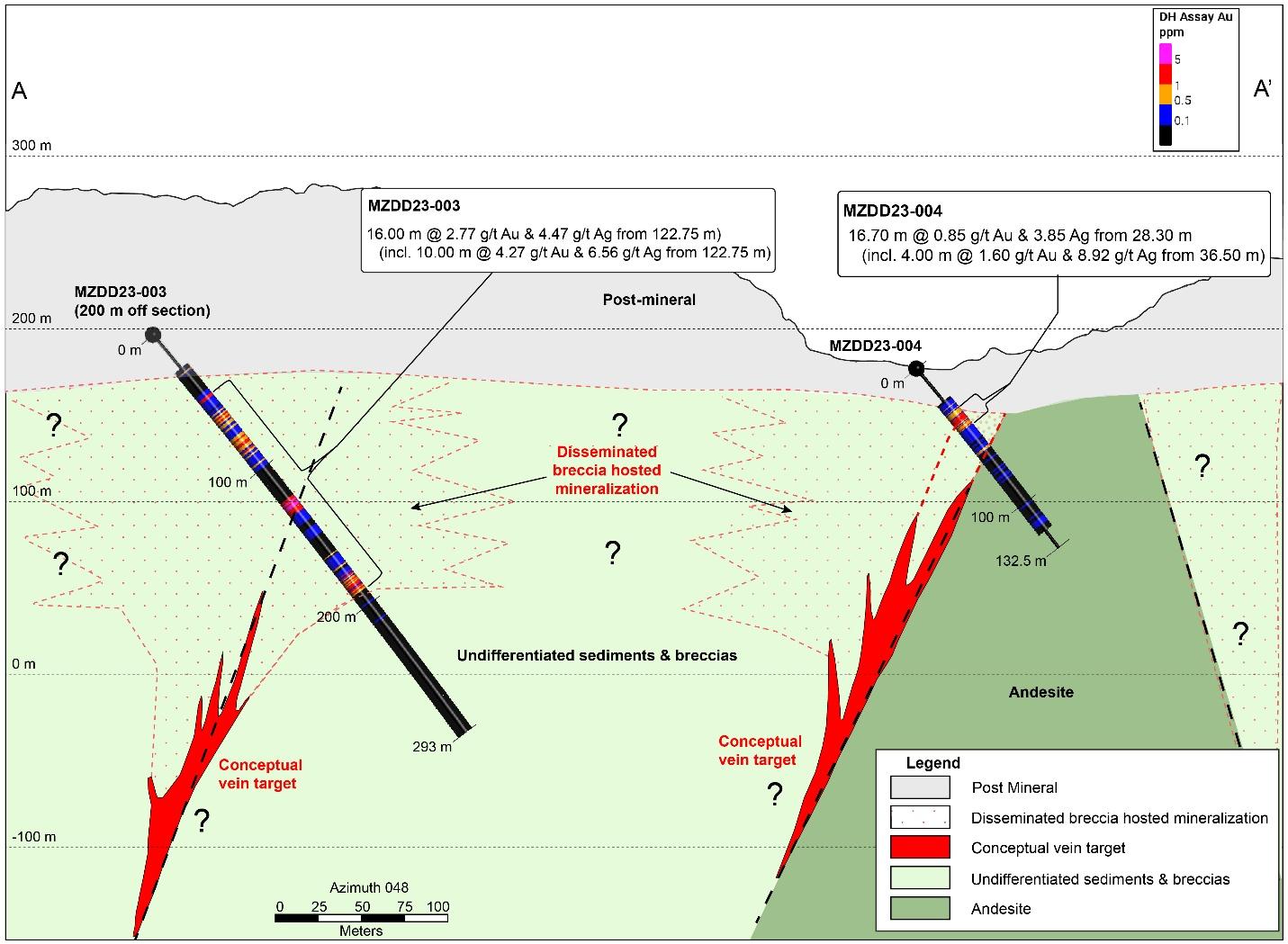
Three phases of drilling have been completed at Mizobe. The drilling has confirmed the presence of broad zones of anomalous gold mineralization and alteration beneath the post mineralization. Seven wide space drill holes intersected mineralization. Best intercepts include:
- 10.0m @ 4.27g/t Au from 122.75m (MZDD23-003) and
- 4.0m @ 1.60g/t Au from 36.5m (MZDD23-004).
Mineralization is associated with localised zones of silification, clay-pyrite alteration, narrow zones of hydrothermal brecciation and anomalous arsenic and antimony. This style of alteration and geochemical association is interpreted to represent the upper or peripheral parts of an epithermal system.
The better developed mineralization is associated with pervasive clay-pyrite-marcasite, which are cross cut by carbonate-quartz-pyrite-marcasite-arsenopyrite breccia and veins and hydrothermal breccia and late stage quartz -carbonate veins. Evidence of colloform banded chalcedony clasts within the breccia.
The Au mineralization is associated As, Sb, Se, Mo and Mn.
The drilling completed to date is wide spaced, so the extent and the controls on the mineralization are still to be defined. The results are highly encouraging as it confirms the potential of discovering new zones of mineralization underneath the post mineralization cover.
Two diamond drill holes totaling 1,156 metres completed at the Mizobe Project intersected gold mineralization and recorded the first intercept of a banded chalcedony vein.
Highlights
- 1.82g/t Au over 1.50m (Drill hole: MZD25-008), from 292.50m
(including 3.53g/t Au over 0.50m from 293.0m). Gold mineralization is associated with sulphide mineralization, silicification, and hydrothermal brecciation, accompanied by anomalous arsenic and antimony (see Figure 3).
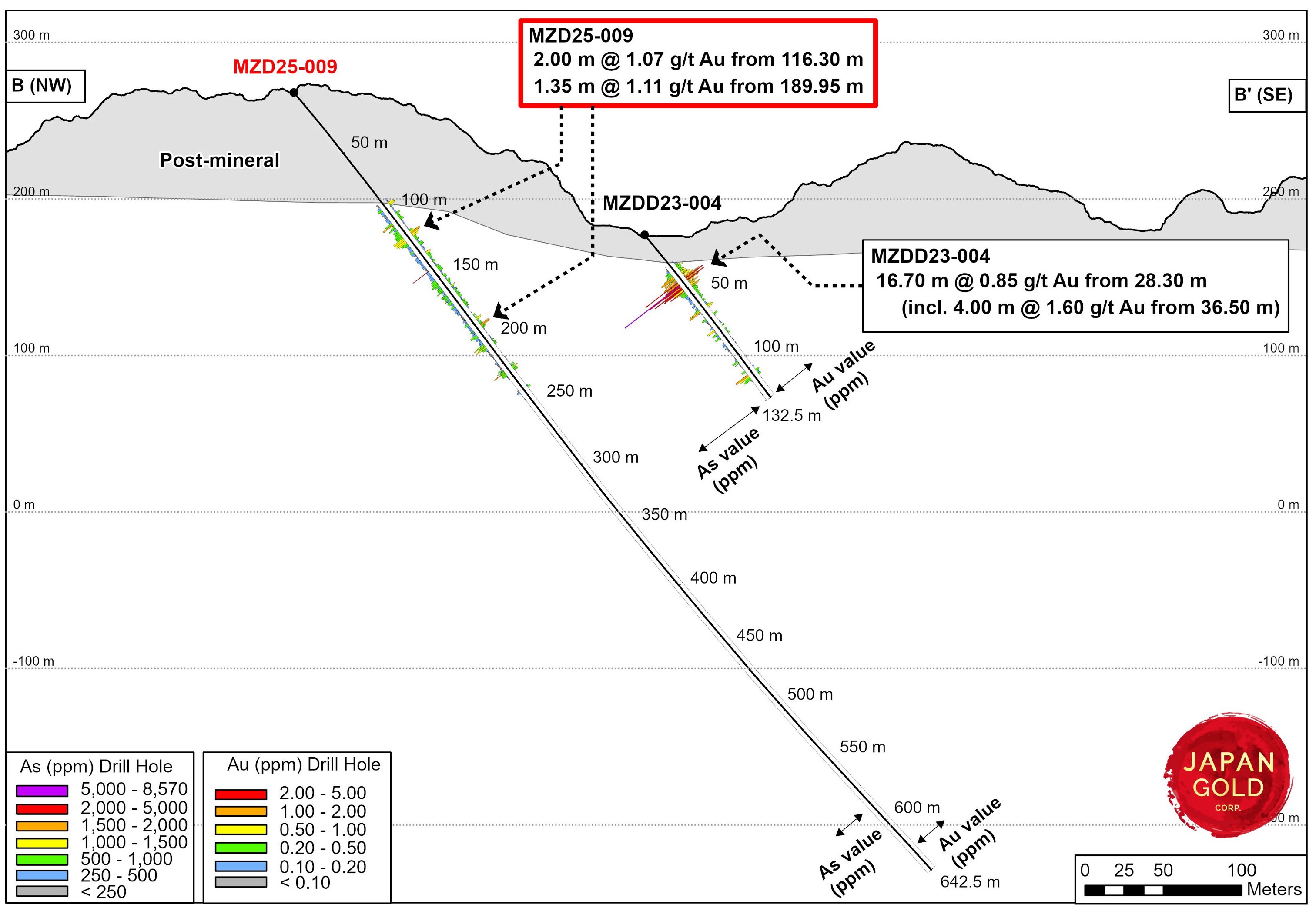
- 1.07g/t Au over 2.0m (Drill hole: MZD25-009), from 116.30m
- 1.11g/t Au over 1.35m (Drill hole: MZD25-009), from 189.95m
- Drill hole MZD25-009 intersected similar mineralization at approximately 116.30m downhole and encountered a banded chalcedony vein at approximately 190.75m (see Figure 4). This vein is discontinuous over an interval of approximately 2.40m and represents the first documented drill intersection of this vein style at the Mizobe Project. This vein style is common of low-sulphidation epithermal environments and may be indicative of the upper levels of a hydrothermal system.
Future exploration will focus on further delineating the extent of the alteration system, improving the understanding of the source and controls of the alteration and associated geochemical anomalies, and evaluating areas with potential for more strongly developed mineralization.
Figure 1 - Mizobe 2025 Drilling Program
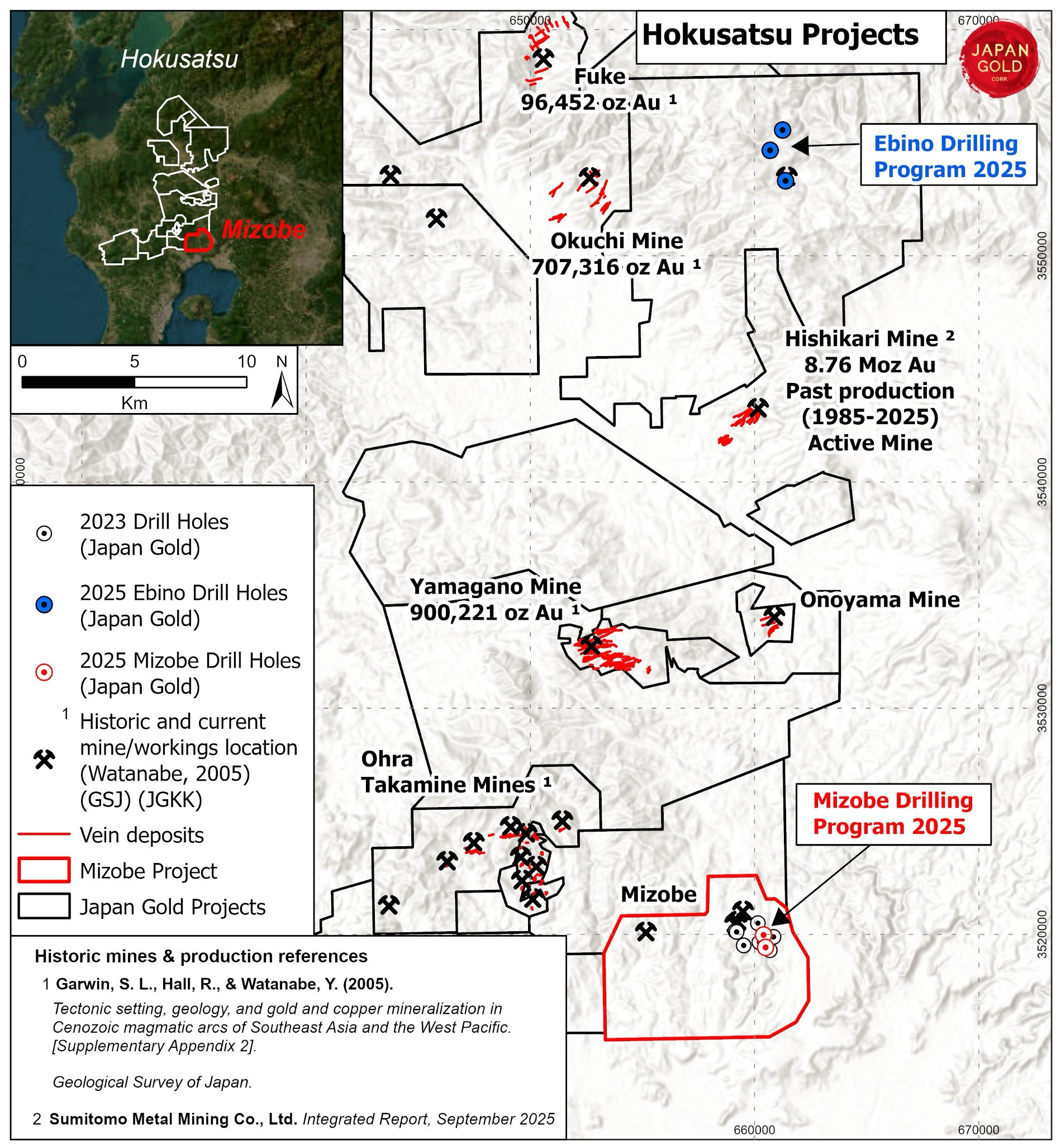
Figure 2 - Mizobe Geology with Planned Drilling
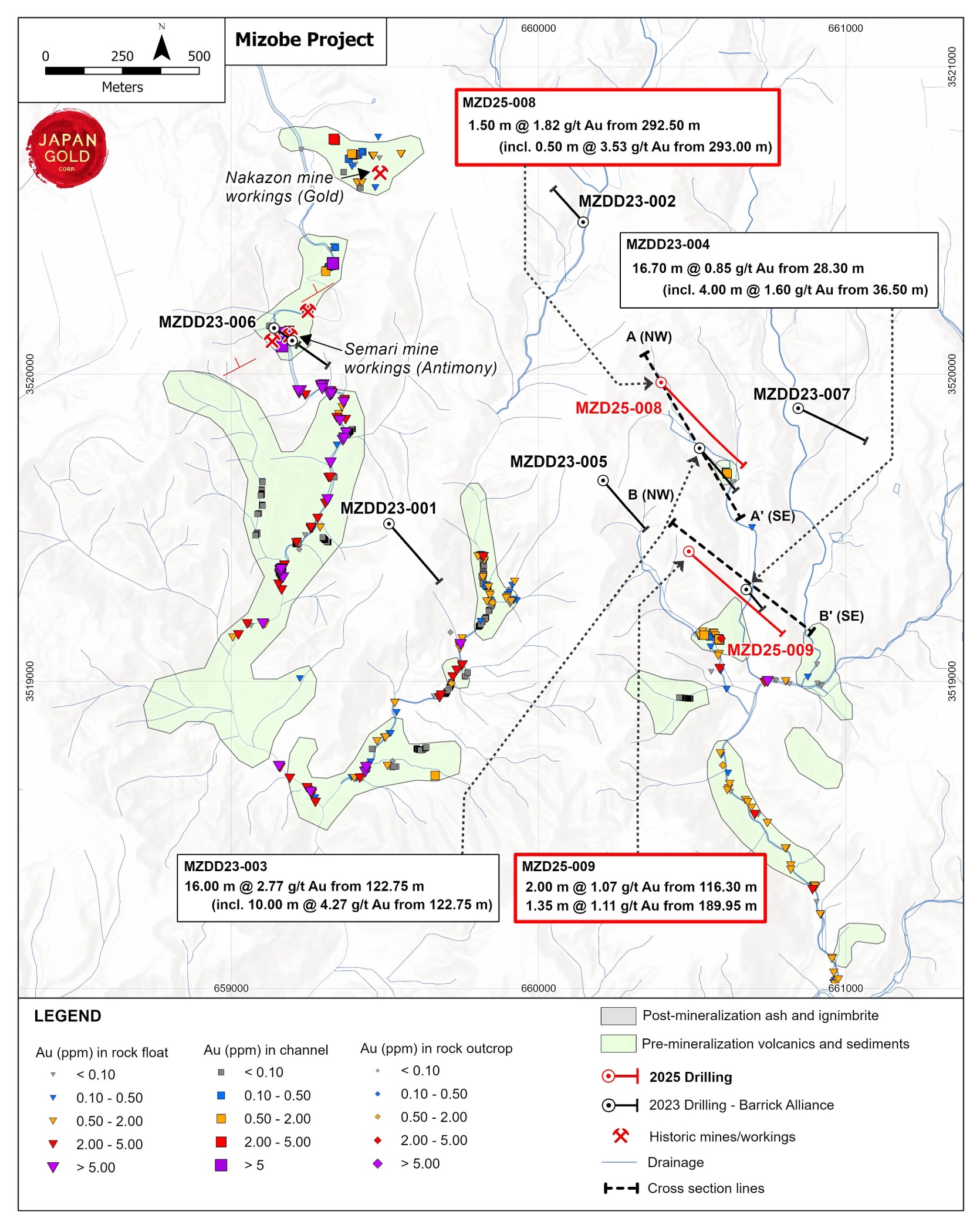
Figure 3 - Mizobe cross section (2025 drill hole MZD25-008)
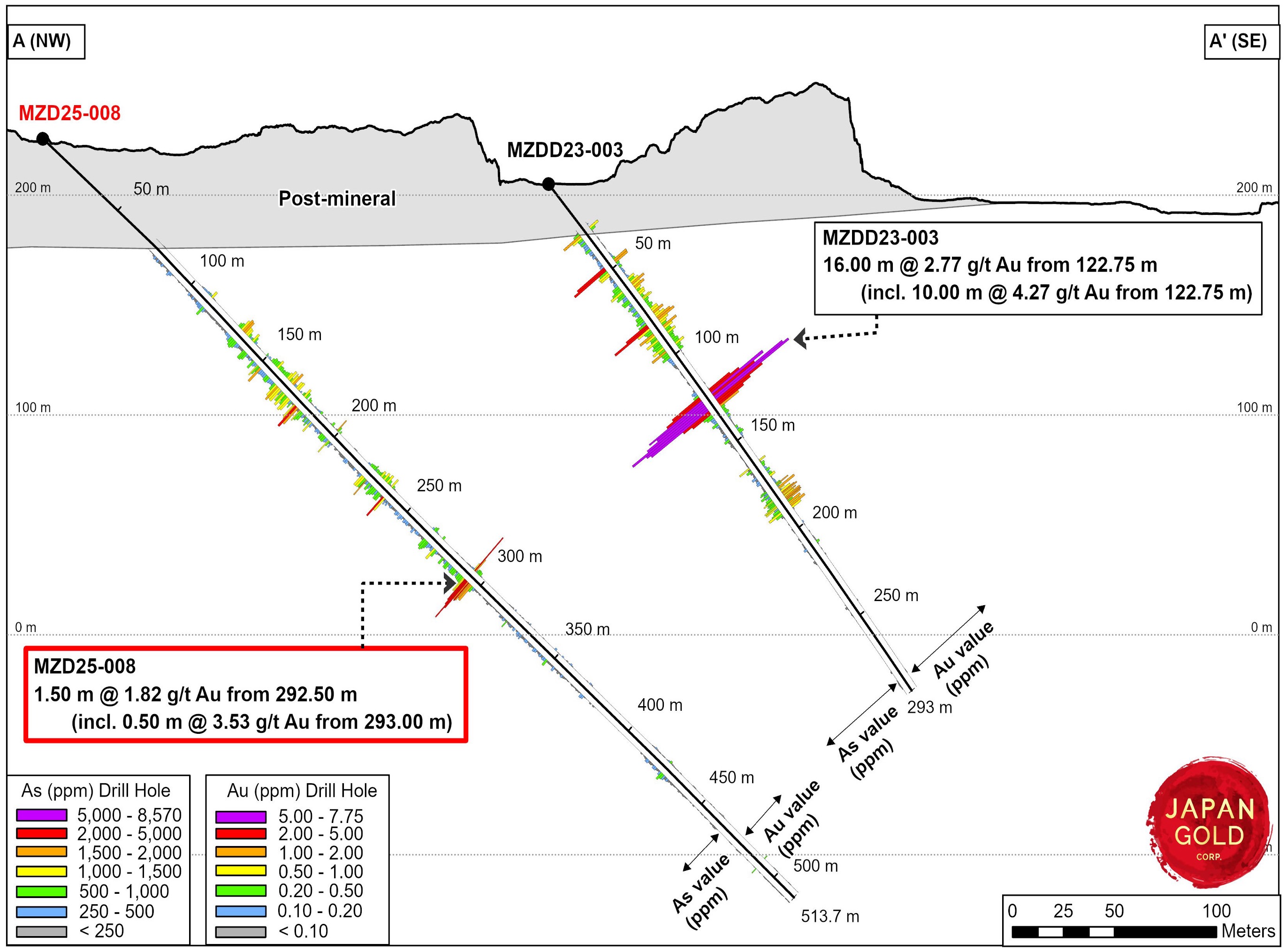
Figure 4 - Mizobe cross section (2025 drill hole MZD25-009)